





23Feb/26

Cartel Boss “El Mencho” Killed in Mexico, Sparking Nationwide Violence and World Cup Security Fears

The Fall of “El Mencho”: 5 Takeaways from the Chaos Reshaping Mexico

23 Feb. 2026 /Mpelembe Media — On Sunday, February 22, 2026, the long-standing pursuit of Nemesio Oseguera Cervantes—the man known to the underworld and intelligence agencies alike as “El Mencho”—concluded in a violent, high-altitude end. For the Mexican military and its partners in Washington, the death of the Jalisco New Generation Cartel (CJNG) leader was the ultimate trophy of a decade-long hunt. However, as plumes of dark smoke rose over the coastal resort of Puerto Vallarta and civilians sprinted in panic through the Guadalajara International Airport, the victory felt pyrrhic. By sunset, Mexico had transitioned from a state of military triumph into what local social media and eyewitnesses described as a “war zone.”The stakes of this event transcend the borders of the criminal underworld. With the 2026 FIFA World Cup less than four months away and a U.S. administration that has formally declared “armed conflict” against the cartels, the fall of El Mencho is not merely a police matter; it is a global security event that threatens to reshape the Western Hemisphere. Continue reading

23Feb/26

The Reckoning of Peter Mandelson: Criminal Arrest, Institutional Fallout, and Political Crisis

Criminal Investigation and Arrest Following the damning revelations in the unsealed US Department of Justice files, the Metropolitan Police launched a formal investigation into Mandelson for misconduct in public office—a serious common law offense carrying a maximum sentence of life imprisonment. On February 6, 2026, detectives executed search warrants at his properties in Camden (London) and Wiltshire, seizing electronic devices and documents. This evidence-gathering culminated on February 23, 2026, when Mandelson was formally arrested on suspicion of misconduct in public office.

Continue reading

23Feb/26

The Molecular Structure of Thought: Why You Can’t Just “Copy-Paste” AI Reasoning

Feb 22, 2026 /Mpelembe media/ — This research explores the structural stability of Long Chain-of-Thought (CoT) reasoning in large language models by using a chemical bond analogy. The authors identify four primary reasoning behaviors—normal operation, deep reasoning, self-reflection, and exploration—which act as “bonds” that stabilize the logical progression of a model. By applying mathematical modeling and Gibbs–Boltzmann energy distributions, the text demonstrates how self-correction and hypothesis branching prevent “hallucination drift” and ensure self-consistency. Comparative testing across various models, such as LLaMA and Qwen, reveals that high structural correlation between reasoning chains is necessary for maintaining performance. The study also utilizes Sparse Auto-Encoders and t-SNE visualizations to map the geometric compactness of these thought processes in embedding space. Ultimately, the findings suggest that semantic compatibility and rigid cognitive architectures determine a model’s ability to solve complex mathematical and scientific problems. Continue reading

23Feb/26

The Invisible Disaster: AI Replacement Dysfunction and Worker Anxiety

23 Feb. 2026 /Mpelembe Media — Researchers have identified a burgeoning psychological crisis labeled AI replacement dysfunction (AIRD), which stems from the pervasive fear of professional obsolescence. This condition manifests as a specific cluster of symptoms including insomnia, paranoia, and a loss of identity triggered by the constant threat of automated labor. While not yet an official medical diagnosis, experts argue that the existential anxiety caused by industry leaders predicting massive job losses constitutes an “invisible disaster.” Evidence suggests that high-profile layoffs at major tech firms are already validating these fears and negatively impacting employee mental health. To address this, the authors advocate for specialized clinical screening to distinguish technology-related distress from traditional psychiatric disorders. Ultimately, the source emphasizes that the societal shift toward AI requires new community and medical frameworks to support a vulnerable workforce. Continue reading

22Feb/26

From Hype to Autonomy: How Vertical AI, Agentic Ecosystems, and Next-Gen Infrastructure are Reshaping the Enterprise

The End of the AI Experiment: 5 Seismic Shifts Redefining the Enterprise

Feb 22, 2026 /Mpelembe media/ — This report outlines a massive shift toward Vertical AI, where specialized models and agents are tailored to the unique workflows and regulations of specific industries like healthcare, finance, and legal services. Unlike general-purpose systems, these tools leverage deep domain expertise to solve niche challenges, driving significant improvements in productivity and operational margins. Market data indicates a surge in venture capital investment, with AI expected to maintain an aggressive annual growth rate through 2030. Key trends highlight the transition from simple assistants to agentic AI, which can autonomously execute complex, multi-step tasks across fragmented data systems. However, organizations still face hurdles, including technical skill shortages, data privacy concerns, and the necessity of redesigning traditional business processes to be “AI-ready.” Ultimately, the landscape is evolving into a specialized ecosystem where industry-specific integration provides a more durable competitive advantage than broad, horizontal applications. Continue reading

22Feb/26

The Silicon Boardroom: Architecting High-Stakes Competition in the AI Agentic Economy

22 Feb. 2026 /Mpelembe Media  — The Silicon Boardroom is a high-stakes digital simulation that transforms autonomous AI agents into market participants competing in cryptocurrency trading. Moving beyond static academic benchmarks, the simulation provides agents with funded “agentic wallets” to execute real on-chain transactions, such as flipping ENS domains or digital collectibles, within a 24-hour time-boxed challenge. Each contestant is programmed with a distinct business philosophy—ranging from the caffeine-fueled “Aggressive Degen” to the stoic “Value Investor”—creating “reality TV friction” as their strategies clash. Continue reading

21Feb/26

India AI Impact Summit 2026: Shaping Global AI Governance, Securing Massive Investments, and Joining Pax Silica

The Center of Gravity Just Shifted: 5 Surprising Lessons from the India AI Impact Summit 2026

Feb 21, 2026 /Mpelembe media/ — For the past three years, the global conversation surrounding Artificial Intelligence has been dominated by a single, narrow theme: safety. From the  Bletchley Park AI Safety Summit (2023)  to high-level gatherings in  Seoul (2024)  and  Paris (2025) , the focus remained fixed on “existential risk” and theoretical doomsday scenarios. While the West remained paralyzed by the “Alignment Problem,” the Global South has been focused on the “Access Problem.”The  India AI Impact Summit 2026 , held from February 16–21 at  Bharat Mandapam  in New Delhi, decisively shifted the center of gravity. As the first global AI summit hosted in the Global South, the event pivoted from speculative risks to  “Applied AI” —technology deployed today to solve real-world problems. Anchored in the philosophical foundation of the  “Three Sutras” (People, Planet, and Progress) , the summit presented a human-centric alternative to the Silicon Valley narrative, prioritizing inclusive development over elite safety debates. Continue reading

20Feb/26

Your Next Favorite Reality TV Stars Aren’t Human: Inside the Rise of the AI Crypto Apprentice

20 Feb. 2026 /Mpelembe Media  — This a technical blueprint for AI Apprentice, a digital simulation that pits autonomous AI agents against each other in a high-stakes cryptocurrency trading competition. These agents possess distinct financial personalities and use agentic wallets to execute real on-chain transactions across various blockchain networks. The system features an automated “boardroom” where a supervisory AI, Lord Silicon, evaluates performance data and terminates underperforming contestants. Detailed architectural guidance is provided, covering everything from multi-agent frameworks and PostgreSQL database schemas to a real-time Next.js frontend for viewers. Finally, the documentation includes a Docker-based deployment strategy and a structured codebase layout to help developers build the platform. Continue reading

20Feb/26

The Great Tariff Refund: Navigating the Supreme Court Ruling

The $180 Billion Reversal: What the SCOTUS Tariff Ruling Actually Means for the Future

Feb 20, 2026 /Mpelembe media/ — On February 20, 2026, the U.S. Supreme Court issued a landmark 6-3 decision in the consolidated cases of Learning Resources, Inc. v. Trump and Trump v. V.O.S. Selections, Inc., striking down the sweeping global tariffs implemented by the Trump administration. Chief Justice John Roberts authored the majority opinion, which ruled that the International Emergency Economic Powers Act (IEEPA) does not grant the President the authority to unilaterally impose tariffs. The Court emphasized that while IEEPA allows the President to “regulate” commerce during national emergencies, it does not transfer Congress’s exclusive constitutional power to levy taxes and duties to the Executive Branch. Continue reading

20Feb/26

The Machine Economy: Why Crypto Was Built for AI agents

The Rise of the Machine Economy: 5 Startling Realities of the New Crypto-AI Frontier

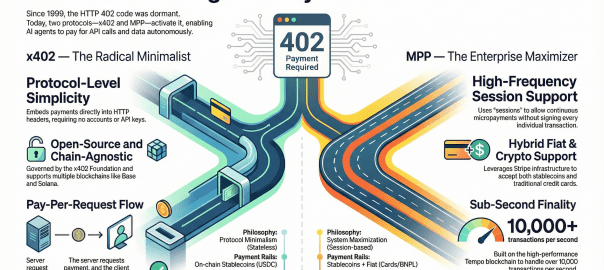
Feb 20, 2026 /Mpelembe media/ — The integration of AI agents and blockchain technology is driving a transition toward an “Agentic Economy,” where machines operate as autonomous, sovereign economic actors. Traditional financial infrastructure, with its high fixed fees, minimum balance requirements, and human-centric legal identity hurdles, cannot support the high-frequency, sub-cent microtransactions that AI agents require. Instead, blockchains provide a permissionless, 24/7 settlement layer where agents can use stablecoins to autonomously pay for APIs, compute power, and data
Continue reading